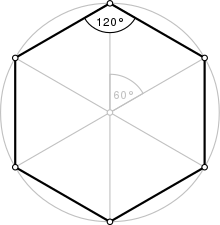
From bees' honeycombs to the Giant's Causeway, hexagonal patterns are prevalent in nature due to their efficiency. In a hexagonal grid each line is as short as it can possibly be if a large area is to be filled with the fewest hexagons.
Depending on the weather conditions, snowflakes often begin as small regular hexagonal plates, formed by water molecules as they freeze. Because each of the hexagon’s internal angles is 120 degrees, such a plate has an unusually stable structure.
Hexagon is a two-dimensional geometrical shape that is made of six sides and six angles. Some real-life examples of the hexagon shape are a hexagonal floor tile, pencil cross-section, clock, honeycomb, etc.
A hexagon is a 6-sided polygon (a flat shape with straight sides): when they join up. Honeycomb has hexagons too! When all angles are equal and all sides are equal it is regular, otherwise it is irregular: A convex hexagon has no angles pointing inwards. More precisely, no internal angles can be more than 180°.
The elegant stone building has an unusual hexagonal chimney. Larger screws tend to have square or hexagonal bolt heads. The hexagonal shaped pencil was developed as an alternative to the round pencil so it would not roll off the desk.
1. Having six sides. 2. Relating to a crystal having three axes of equal length intersecting at angles of 60° in one plane, and a fourth axis of a different length that is perpendicular to this plane. The mineral calcite has hexagonal crystals. See more at crystal.
In geometry, a hexagon can be defined as a closed two-dimensional polygon with six sides. Hexagon has 6 vertices and 6 angles also. Hexa means six and gonia means angles. Hexagon in Real Life. We can find the shape of a hexagon in a honeycomb, a football, face of pencil, and floor tiles.