 In science and engineering, a semi-log plot / graph or semi-logarithmic plot / graph has one axis on a logarithmic scale, the other on a linear scale. It is useful for data with exponential relationships, where one variable covers a large range of values.
 Graph functions, plot points, visualize algebraic equations, add sliders, animate graphs, and more.
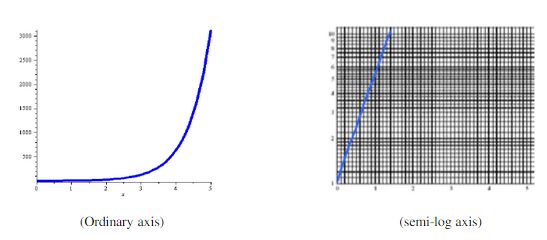 Logs are helpful when plotting certain types of data. There are two types of log graphs that can be used when plotting data. The first is called a semi-log graph. In a semi-log graph the y-axis is logarithmic, which means the separation between the ticks on the graph is proportional to the logarithm of numbers.